Français/French Deutsch/German Italiano/Italian Português/Portuguese Español/Spanish 日本語/Japanese 한국어/Korean 中文(简体)/Chinese
Simplified
Select Language:

Wednesday, August 20, 2008

Magical Objects - Other uncategorized objects


These objects remain uncategorized as they are the only in their field.

Gubraithian fire

Gubraithian Fire is a conjured everlasting magical fire that may only be created by extremely skilled wizards. First mentioned in Harry Potter and the Order of the Phoenix, Rubeus Hagrid and Madame Maxime give a branch of Gubraithian fire (conjured by Dumbledore, to burn atop the branch) as a gift to the giant leader during their journey.

Marauder's Map


The Marauder's Map is a magical map of Hogwarts which makes its first appearance in Prisoner of Azkaban. The map was created by the four students known collectively as "The Marauders" at Hogwarts. During their time there, they gained extensive knowledge about the school grounds, such as its various hidden passages, from their frequent night-time adventures together. These marauders were James Potter (Prongs), Sirius Black (Padfoot), Remus Lupin (Moony), and Peter Pettigrew (Wormtail).

At first glance, the Map is simply a blank piece of parchment; but when the user points their wand to the Map and says, "I solemnly swear that I am up to no good," the message "Messrs Moony, Wormtail, Padfoot and Prongs, purveyors of aids to magical mischief-makers, are proud to present the Marauders Map," and a detailed layout of Hogwarts' Castle (including secret passageways) is revealed.[HP3] Saying, "Mischief managed!" returns the map to its original blank state.[HP3] The Map gives information on how to open secret passageways, though several locations (such as the Room of Requirement and the Chamber of Secrets) do not appear on the map. It would seem that the four friends either did not have any knowledge of them, or-in the case of the former-they are unplottable. Furthermore, Animagus disguises or Invisibility Cloaks cannot fool the Marauder’s Map. Not even Polyjuice Potion can outwit the Marauder's Map. For this reason, Barty Crouch Jr., disguised as Moody, considered it a threat and asks to 'borrow' the map from a trusting Harry.

In Prisoner of Azkaban, Fred and George (who have no further need for it) give the Map to Harry so he can get to Hogsmeade Village through a hidden passageway. Snape later on found the Map in Harry's possession and tried to force it to reveal its secrets. It merely insulted him with mocking phrases, the Map retains an echo of its creators' personalities, much like the Sorting Hat remembers the thoughts and opinions of the school founders; the marauders had no happy memories of Snape. Lupin later took it with him. He returns the map to Harry after resigning his post at Hogwarts. The Map then on makes insignificant appearances in the books.

In the series, the Map is depicted as a piece of parchment; in the films, the Map appears with a cover that unfolds in two with many other folds inside each other. All the lines in the Map are made up of what at first glance are just random letters, but upon closer inspection are Latin words. In the books, there is no mention of Harry recovering the Map from the office of the Professor Moody impostor and Harry later uses it in upcoming books. When asked, J. K. Rowling answered that Harry had indeed sneaked into the office and recovered it in the days following the Third Task. She also commented that she had intended to include a scene or mention it. When asked during an online question session, "What child did Harry give the Marauders Map to if any?" (After his school years), Rowling responded "I’ve got a feeling he didn’t give it to any of them, but that James [one of Harry's sons] sneaked it out of his father’s desk one day."[19] This is expected, as James Potter, the boy's grandfather, was also a mischief-maker.

Omnioculars

Omnioculars are a pair of magical brass binoculars used by Harry, Ron, and Hermione in the fourth book during the Quidditch World Cup. Omnioculars, besides having magnified lenses, have many other features. Among them, the ones mentioned are the ability to replay or slow down something seen through the lenses, although a side effect is that the view in the lenses is not accurate of what is currently happening, since it's going slower than real life. They also have a play-by-play feature, where the names of moves performed by Quidditch players is shown in bright purple letters across the Omnioculars' lenses.

Spellotape

Spellotape is magical adhesive tape. The name is a play on Sellotape, a popular brand which has become a generic name for transparent adhesive tape in the United Kingdom.[20][21]

Spellotape is referenced in all of the Harry Potter books, apart from Deathly Hallows, and is seen in the second film.

Magical Objects - Wands


A wand is a part of a wizard's everyday accessory, used to perform magical feats, and without which only limited magic is possible. They are used as both tools and weapons in the Wizarding World. Wands are generally carried inside the wizard's robes in the books; however, they can also be placed into other objects. For instance, Hagrid hid the broken halves of his wand inside his umbrella. In the Harry Potter universe, when a wizard has committed a serious crime, their wands are snapped in half.

The only named wand shop is Ollivander's. This is where Hagrid takes Harry to buy his first wand. In the "Weighing of the Wands" chapter of Harry Potter and the Goblet of Fire, Ollivander is seen to evaluate two foreign wands: Krum's wand: a Gregorovitch creation, unusually thick; and Fleur's wand, whose core (a hair from her Veela grandmother) he felt created "temperamental" wands, which is why he did not use it himself.

Creation

A wand is made by a wandmaker learned in wandlore, the study of wands. Wands are handcrafted from "wandwood", which is a wood capable of sustaining magic (e.g. Holly, Yew, ebony, vinewood, etc.). Then a core is inserted into the middle of the wand from top to bottom. Such cores have been mentioned to include phoenix tail feathers, unicorn tail hairs, dragon heartstrings and Veela hair. The books mention that Ollivander only uses phoenix feathers, dragon heartstrings and unicorn hair as the cores of his wands. In the Deathly Hallows, the Elder Wand is described as having a core made from the tail hair of a Thestral.[22]

Effects

A wand is generally considered personal for a wizard. However, wands belonging to other wizards can be used to a comparatively less potent effect. In Philosopher's Stone, Harry had to try out many wands before he found one that "chose him". It was an 11-inch (280 mm), holly and phoenix feather wand.

Wands with cores from the same source give strange effects (Priori Incantatem) when forced to fight each other, as is the case with Harry and Voldemort's wands. In Goblet of Fire, it is revealed that each of their wands contains a tail feather from Fawkes, the phoenix belonging to Dumbledore. After Priori Incantatem, the wands get to know the opposites' master - this is explained in Deathly Hallows.

Wands are capable of changing masters. This is revealed in Deathly Hallows. When a wizard or witch is defeated, or if their wand is forcibly taken from them in a fight (a form of defeat), the wand will change its allegiance to the one who defeated its previous master and work perfectly well with its new master. It is unclear if the wand will continue to work properly for its original master if it is returned (not taken back in a fight). However, any wands removed from the owners using Expelliarmus (other than Dumbledore when disarmed by Draco in Half Blood Prince), seem to not change allegiance. If they have, they work perfectly well for their original masters when they retrieve them.

Magical Objects - Quills


Anti-Cheating Quill

The Anti-Cheating Quill, a quill with an anti-cheating charm on it, first mentioned in Philosopher's Stone.[PS Ch.16] Although it is not mentioned in other exams, it is presumably used for all the exams Harry takes at Hogwarts.

Blood Quill

The Blood Quill is used by Umbridge throughout Order of the Phoenix to carry out her perverse punishment of "cutting up" students. In the fifth book, Harry has detention with Umbridge on several occasions. During these detentions, he is required to write lines (I must not tell lies), and is not released from this until Umbridge believes "the message has sunk in." Rather than using a regular quill, Umbridge makes Harry use a blood quill, which is described as unusually sharp with a black nib. As the user writes, the quill magically (and painfully) cuts into the back of the user's hand and uses their blood for ink. When carried out repeatedly over a period, this can lead to permanent scarring, as shown by Harry to Rufus Scrimgeour in the last two books. Another victim of this form of detention is Lee Jordan. In the film interpretation, all members of Dumbledore's Army were punished using this method.

Quick Quotes Quill

A Quick Quotes Quill is a stenographic tool employed by Rita Skeeter to spin the words of her subjects into a more salacious or melodramatic form more to her liking. Because she sucks on it first before writing (which then the quill writes to her liking), it is speculated that the quill will also write to the likings of others (as long as he or she sucks it before it begins writing).

Rita uses the quill to interview Harry (inside a Hogwarts broomstick cupboard) about his participation in the Triwizard Tournament in Goblet of Fire for her column "Me, Myself, and I" in the newspaper, The Daily Prophet. Harry continually tries to correct the inaccuracy of the quill to Rita. However, she rudely ignores him. Additionally in Deathly Hallows, Rita mentions in her interview concerning Dumbledore's posthumous biography that the Quick Quotes Quill helped her to write the book so quickly after his death.

Magical Objects - Transportation


Broomsticks

Broomsticks are used for transportation by wizards and witches of all ages, and for the game of Quidditch. Their use is similar to that of flying carpets, although the latter are banned in Great Britain. However, they are uncomfortable for extensive trips, even with the cushion charm.

Broomsticks are treated as a major consumer product in the Wizarding world. There are numerous brands and models of brooms, all of which vary in their capabilities. These range from expensive high-performance models to toy broomsticks for young children that only fly a few feet off the ground to even family-sized broomsticks that have room for an entire family to sit down on and have a luggage compartment below the seating area. The cultural significance of broomsticks in the world of Harry Potter is similar to that of the real life automobiles.

Since Harry Potter plays Quidditch, his brooms - a Nimbus 2000, and later a Firebolt - are prominent in the series. The Nimbus 2000 was given to him by special consent of Dumbledore via Professor Minerva McGonagall, who had chosen him as Seeker.[HP1] The Firebolt was given to him by Sirius as a Christmas gift.[HP3] The Firebolt remains the fastest broom in the world, having surpassed the previous record holder, the Nimbus 2001, and its price is so grand that it is only available upon request (Harry Potter never asks for the price, and thus it remains unknown). However Harry loses his Firebolt in Deathly Hallows and it is unknown what he replaces it with afterwards, or if he does at all.

Cars and Motorbikes

Enchanted motor vehicles appear in most of the books.

In Chamber of Secrets, Ron and Harry miss the train and travel to Hogwarts in Ron's father's car, a flying Ford Anglia.

Sirius owned a flying motorbike, which he lent to Hagrid the night James and Lily Potter died; it is first seen when Hagrid delivers the baby Harry to Number Four, Privet Drive in the first book, and then again when Hagrid uses it to help Harry escape from the Dursley's in the seventh book.
Knight Bus

The Knight Bus is a heavily enchanted, violently purple, triple-decker bus that transports wizards and witches. It makes its first appearance in Prisoner of Azkaban where Harry unintentionally hails it by holding his wand arm out. Harry has a final ride on the Knight Bus with a number of his friends in Order of the Phoenix. The Knight Bus is faster than travelling by broomstick, but not as fast as near instantaneous Floo powder and Apparating. The bus charges for the service; Harry Potter is charged 11 Sickles to travel from the town of Little Whinging to The Leaky Cauldron[HP3].

The bus functions as public transportation for the wizard or witch who cannot or will not choose another means of transportation. The riders are seemingly picked up by the bus from all over in-universe Great Britain, bringing passengers to the destinations of their choice with seemingly no set route. It bolts through the streets, entirely invisible to muggles and causes other objects to dodge it (rather than dodging the objects) for travelling short distances. For longer distances, the Knight Bus makes 160 km (hundred-mile) leaps accompanied by a great bang and jolt. The interior of the bus changes depending on the time of day, having seats by day and beds by night. The only mentioned limitation in travelling is that it cannot enter water.

The conductor of the Knight Bus is Stan Shunpike, and its driver is Ernie Prang in the third book of the series. In the third film, Stan is accompanied by a talking shrunken head voiced by Lenny Henry.

Floo Powder
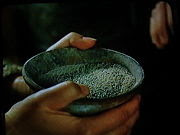
Floo powder is a glittering powder used by wizards to travel and communicate using fireplaces. It was invented by Ignatia Wildsmith (1227-1320) and named after the flue, which is the passageway that leads from a fireplace to the chimney so hot gases can escape. Strangely, flues did not exist at the supposed time of Floo powder's invention. It is possible that the muggles could have taken the word from the wizards and made it their own.

Floo powder can be used with any fireplace connected to the Floo Network. To transport from one fireplace to another, the traveller throws a handful of the Floo powder into the fireplace, steps into the fireplace, and states the intended destination in a clear and purposeful voice. Floo Powder can also be used for communication; a wizard or witch can kneel in front of the fire and stick their head into the fire, which will appear in the fire at another fireplace, leaving the witch or wizard free to talk.

In Chamber of Secrets, the Weasleys travelled to Diagon Alley by Floo powder. Harry did not say "Diagon Alley" clearly: he coughed while saying "Diagon Alley" so he was instead sent to Borgin and Burkes, in Knockturn Alley. In the fourth book, Arthur Weasley uses his position at the Ministry of Magic to have the Dursleys' fireplace temporarily connected to the Floo network, unaware that the fireplace had been blocked. Sirius uses the network to communicate with Harry in the same book. In the fifth book, Harry uses the Gryffindor fireplace and finally Dolores Umbridge's fireplace to communicate with Sirius; he is however forced to do so because Umbridge is monitoring all other lines of communication in and out of Hogwarts (thus why he did not communicate through Gryffindor's). The Floo Network is controlled by the Ministry of Magic. The Ministry also has over 700 fireplaces in its headquarters so ministry officials and workers can teleport straight from their homes to the ministry without the hustle and bustle of travelling on broom or by portkey.
Flying carpets

Flying carpets are usually thick rugs, frequently highly patterned and often manufactured in the Middle East that are enchanted with the ability to fly.[original research?] Flying Carpets were once an accepted form of travel for the British magical community, but they are now banned due to being defined as a "Muggle Artifact" by the Registry of Proscribed Charmable Objects. It is therefore now against British wizarding law to charm carpets or fly them, although they are still legal in other countries. Arthur Weasley was very much involved in the introduction of this legislation due to his position in the Misuse of Muggle Artifacts office. It is known that the ban was relatively recent, not only from Arthur's involvement, but also from the fact that Barty Crouch Sr's grandfather owned a 12-seater Axminster carpet before flying carpets were prohibited.

A wizard merchant by the name of Ali Bashir is very keen to import flying carpets into Britain and is very upset that local laws are preventing him from doing so. He regularly berates Arthur about the subject, but it is very unlikely that the law will be changed.

Portkeys

The Portkeys are first mentioned in Goblet of Fire. Once created by using the Portus spell, a Portkey can be set to transport anybody who touches it to a designated location, or to become active at a pre-determined time and transport to that location anybody who happens to be touching it at the moment of activation. The creation of Portkeys may be highly restricted in general; although Dumbledore is able to set up an "unauthorised Portkey" in the fifth book, it is treated as a serious crime; Fudge is upset that Dumbledore would create one in front of him, and at one point Remus Lupin says "...it's more than our life's worth to set up an unauthorised Portkey."

In the Harry Potter series, a portkey is usually made from an unobtrusive object or bit of rubbish, to prevent Muggles from discovering their magical nature. When activated, the user feels a pulling or jerking sensation behind the navel, and then suddenly appears at the destination.[HP4] With enough practice, a graceful landing is possible: after the Portkeyed trip to the Quidditch World Cup in fourth film, Cedric Diggory, Arthur Weasley, and Amos Diggory landed on their feet, while the others (Harry, Ron, Hermione, Ginny and the twins) fell onto the ground.

In Goblet of Fire, Crouch Jr., who was impersonating Moody, made the Triwizard Tournament cup a Portkey so it would transport anybody who touched it straight to the hands of Voldemort, expecting it would be Harry. However, Harry took the cup together with Cedric, so Pettigrew murdered Cedric.
Time-Turners
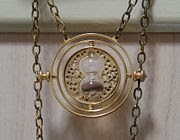
A Time Turner may be used for time travel. A large supply of Time-Turners is kept at the Ministry of Magic, as seen in Order of the Phoenix; however, during the events of that book a glass-fronted cabinet containing Time-Turners is destroyed. Due to their time-affecting properties, the cabinet is seen to fall, shatter and repair itself repeatedly. In Half-Blood Prince, Hermione mentions a Daily Prophet article stating that "the entire stock of Ministry Time-Turners" was destroyed during that incident. The books do not discuss who else may be in possession of Time-Turners outside of the Ministry.

Hermione receives a Time-Turner from McGonagall in Prisoner of Azkaban, so she could attend more classes than time would normally allow. Hermione is ordered to keep it a secret from everyone, including Harry and Ron, although they do notice the impossibility of her schedule, and several bizarre disappearances and reappearances- the increased schedule does leave her strained towards the end of the year, however. Hermione lets Harry and Ron in on the secret near the end of the book, where she and Harry use the Time-Turner to save Sirius and Buckbeak.

Hermione's Time-Turner resembles an hourglass pendant on a necklace; it is unclear if all of them do. The hourglass pendant is twisted to move through time, and the number of turns on the hourglass corresponds to the number of hours one travelled back in time. The travel ends as the traveller arrives to the point in time of which s/he went back in time (e.g. Hermione and Harry go back three hours; three hours after their arrival in the past, they return to the time period they turned back).
Vanishing Cabinet

The Vanishing Cabinet is a cabinet located in Hogwarts that is a part of a set of two; the other cabinet resides in Borgin and Burkes. One simply enters a cabinet at one location and exits the cabinet at the other location.

The Vanishing Cabinet is first seen in Chamber of Secrets when Harry in mistakenly transported to Borgin and Burkes in Knockturn Alley and hides in it to elude Draco and the man that appears to be his father. That cabinet's counterpart is mentioned in Chamber of Secrets when Sir Nicholas de Mimsy-Porpington convinces Peeves to drop it (thus breaking it) over Argus Filch's office in order to help Harry escape detention for "befouling of the castle" (tracking in mud). It was also used in Order of the Phoenix by Fred and George, when they forced Montague, the Slytherin Quidditch captain and member of the Inquisitorial Squad into it when he tried to take house points from Gryffindor. Draco then learns of Montague’s experience, learning that you could transport between the two cabinets and that the other is located in Borgin and Burkes. He later tells Voldemort of this and is instructed to fix the broken one at Hogwarts as so to transport the Death Eaters into the highly secured castle.

In Half-Blood Prince Draco visits the dark shop to ask for instruction in fixing the one broken Cabinet placed in the Room of Requirement at Hogwarts after Peeves broke it by dropping it in Draco's second year. After Draco pales and becomes fatigue in his complex struggle to fix the cabinet, he madly yells in triumph as he succeeds and allows the Death Eaters to finally enter the school. Thus, a chaotic battle begins in the castle between them and the Order of the Phoenix, ultimately leading to Dumbledore's death.

Magical Objects - Storage receptacles


Moody's Magical Trunk

Alastor Moody owns an especially bewitched magical trunk. It has seven locks on it, and the trunk opens to a different assortment of objects for each lock. Most notably, though, the seventh compartment is about 10 feet (3.0 m) deep (possibly because of the use of an Undetectable Extension Charm), and is where Barty Crouch Jr. imprisoned the real Moody. Other compartments contain spellbooks, Dark Detectors, and Moody's Invisibility Cloak.
Pensieve

A Pensieve is a stone receptacle in which to store memories. Covered in mystic runes, it contains memories that take physical form as a type of matter that is described as neither liquid nor gas. A witch or wizard can extract their own memories or another person’s, store them in the Pensieve, and review them later. It also relieves the mind when it becomes cluttered with information. Anyone can examine the memories in the Pensieve, which also allows viewers to fully immerse themselves in the memories stored within, much like a magical form of real world virtual reality.

Users of these devices view the memories from a third-person-point-of-view, providing a near-omniscient perspective of the events preserved. This, of course, raises questions of how they are able to see things beyond what they have remembered. Rowling answered this question in an interview, confirming that memories in the pensieve allow one to view details of things that happened even if they did not notice or remember them, and stated that "that's the magic of the Pensieve, what brings it alive".[17] The "memories" contained in the Pensieve have the appearance of silver threads. Memories that have been heavily manipulated or tampered with to alter perspectives, or are simply aged and gone-spoiled (such as Horace Slughorn's), may appear thick and jelly-like and offer obscured viewing. Memories are not limited to just those of humans, since at least one house-elf (Hokey) provided Dumbledore with a memory as well.

Dumbledore's Pensieve first appears in Goblet of Fire, again in Order of the Phoenix, and plays a pivotal role in Half-Blood Prince. It makes a last appearance in Deathly Hallows when Harry uses it to decipher Snape's memories.

Hermione's small beaded handbag
Hermione used an Undetectable Extension Charm on her handbag which contains almost everything they need when they disapparate from Bill and Fleur's wedding reception. It contained jeans, sweatshirts, socks, the Invisibility Cloak, Polyjuice Potion, books, a tent, essence of dittany (a liquid extract that can be used to heal wounds quickly) and even Phineas Nigellus Black's portrait, along with other various items.

Welcome to the World Of